

Your Upwork profile isn’t about you. It’s about the client.
Most beginners write profiles that read like resumes, a list of what they’ve done, who they are, and what they’re hoping to find.
Clients don’t care about any of that until they know you can solve their problem.
Flip that around, and you’ll stand out from 90% of the profiles they scroll past.
I’m not going to tell you to fake experience you don’t have.
I’m going to show you how to take what you already have — and frame it the way clients actually need to see it.
Here’s how to build a profile that gets responses, even starting from zero.
Write a headline that speaks to the client’s problem, not your background
The highest-earning freelancers on Upwork all have one thing in common their headline isn't about them. It's about the client. Most beginners get this backwards.
Here’s is a good example:
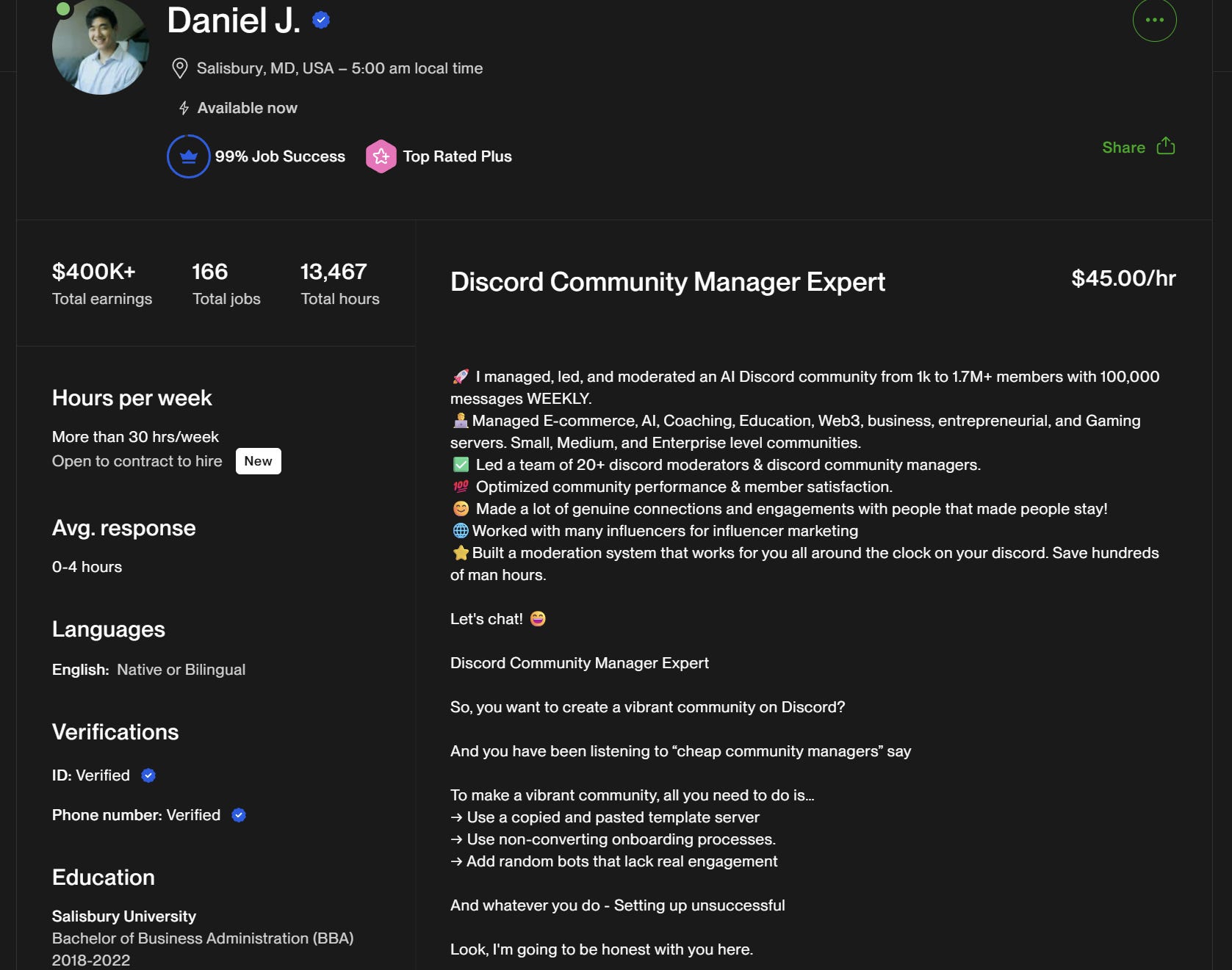
“Motivated freelancer looking for opportunities” tells a client nothing about what they’ll get from hiring you.
Instead go straight to the point, what you do and
Step 2: Write a bio that translates your experience into professional language
Clients aren’t hiring your backstory. They’re hiring your ability to deliver something they need. That said — your experience running a household is genuinely relevant. You just need to translate it.
Managed the household budget for a family of five → bookkeeping, financial tracking, admin
Coordinated kids’ schedules, appointments, and activities → project coordination, calendar management
Ran a school volunteer committee → event coordination, communication, team management
Wrote social content for a local parent group → content creation, social media management
Pick 2–3 of your actual responsibilities and rewrite them the way a job posting would describe them. Then open your bio with your offer — not your history.
Step 3: Add portfolio samples — even if nobody has paid you yet
Here’s the truth: clients can’t tell whether a sample was a paid project or something you made last Tuesday.
They care whether the work is good and relevant — not whether it had an invoice attached. So this week, make one sample. Pick the service you want to offer, pick a fictional client in an industry you understand, and create the deliverable.
Label it clearly: “Sample: Weekly newsletter for a health and wellness coach.” Upload it. That’s your portfolio. One good sample beats a blank section every single time.
Step 4: Set your rate strategically — not at rock bottom
The clients who search for the lowest possible rate are also, almost always, the hardest to work with.
Do this instead:
Search Upwork for your service category.
Look at what beginner-to-mid-level freelancers charge — not the top earners, but people with 10–30 reviews.
Find the middle of that range. Start 10–15% below the middle. Not 50% below. Not at the floor.
You’ll attract better clients. And you’ll have room to raise your rate after your first few jobs without a jarring jump.
Why this works when the typical beginner profile doesn’t
Three things are happening here that most profiles miss.
First, it speaks the client’s language. Clients scan for a solution to their problem — a profile written from their perspective stops the scroll.
Second, it removes the “no experience” objection before it comes up. A clear offer plus a relevant sample shows capability, not history.
Third, it positions you as a professional, not a desperate beginner. A clear headline, a confident bio, and a strategic rate all signal that you take your work seriously — even if you’re just getting started.
Your first Upwork profile doesn’t need to be perfect. It needs to be clear.
Pick one service, write for the client, add one sample, set a sensible rate — then apply to five jobs this week. The profile gets better from feedback, not from more tweaking.
Before You Go ……
I built something that fixes this for you. The KTC Upwork Profile Builder Prompt — 16 questions, one sitting, a complete profile that sounds nothing like everyone else's. 👉 It's free. Get it below.